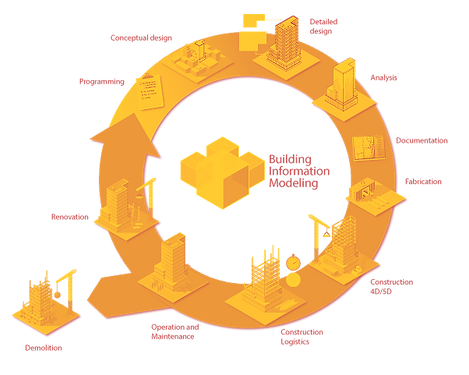


What is BIM? is a concept that has revolutionized the approach to design, investment implementation and building management. BIM, ie Building Information Modeling, enables continuous and immediate access to information about the project, its costs and schedules. It also simplifies the design process by the possibility of testing various variants and schemes in a virtual world in order to select the optimal one. The test results are consistent and reliable thanks to the increasingly better reflection of reality through one digital model. It can be used to make design decisions, develop a consistent construction documentation, and analyze profitability and estimate investment costs, and ultimately also to manage the facility. By working on one model, companies involved in the design, construction and management of a building can significantly increase their efficiency and reduce the number of errors occurring in the entire documentation process. Digital design data combined with innovative parametric information modeling technology offers significant advantages over traditional design and build methods.
The most important issue in BIM projects is coordination and communication, while the multi-industry ones are one of the most difficult to implement. In a situation where structures, architecture, installations, production lines, technology park and underground installations have to be planned for one facility, the risk of making a mistake is much greater. Therefore, in order to largely or even completely eliminate them, mutual coordination is needed. Each designer from a particular industry should also take into account other elements beyond his scope, because he must remember that his work has an impact on other participants in the process. If, on the other hand, there is one environment in which all branches are visible at once, and still in 3D, you can quickly remove the collision or route your models to avoid it. What's more, in addition to a purely visual manual tool, it is also possible to use automatic tools that will pick up similar errors. Everyone sees the same multi-industry model, thanks to which there is a constant flow of information about different concepts and solutions to a given problem. This facilitates coordination meetings, during which you can change the concept of the assembly line, structure or installation on an ongoing basis and look for a solution that is optimal not only for process participants, but also for the project itself. This is another social aspect of BIM - when implementing this technology, people of different specializations start working together, talking to each other and solving problems together. BIM does not reduce the tension and stress associated with the project, but it does increase the level of communication between designers, which avoids many costly mistakes resulting from misunderstandings.
Construction is a sector that has to meet constantly growing requirements. The consequence of changes and development is the continuous improvement of IT solutions that allow grouping, processing and sharing data about the building at any time and the entire team involved in the project. This possibility is given by BIM.